
Single-Player Mode
What happens when a coding agent becomes your team's operating system

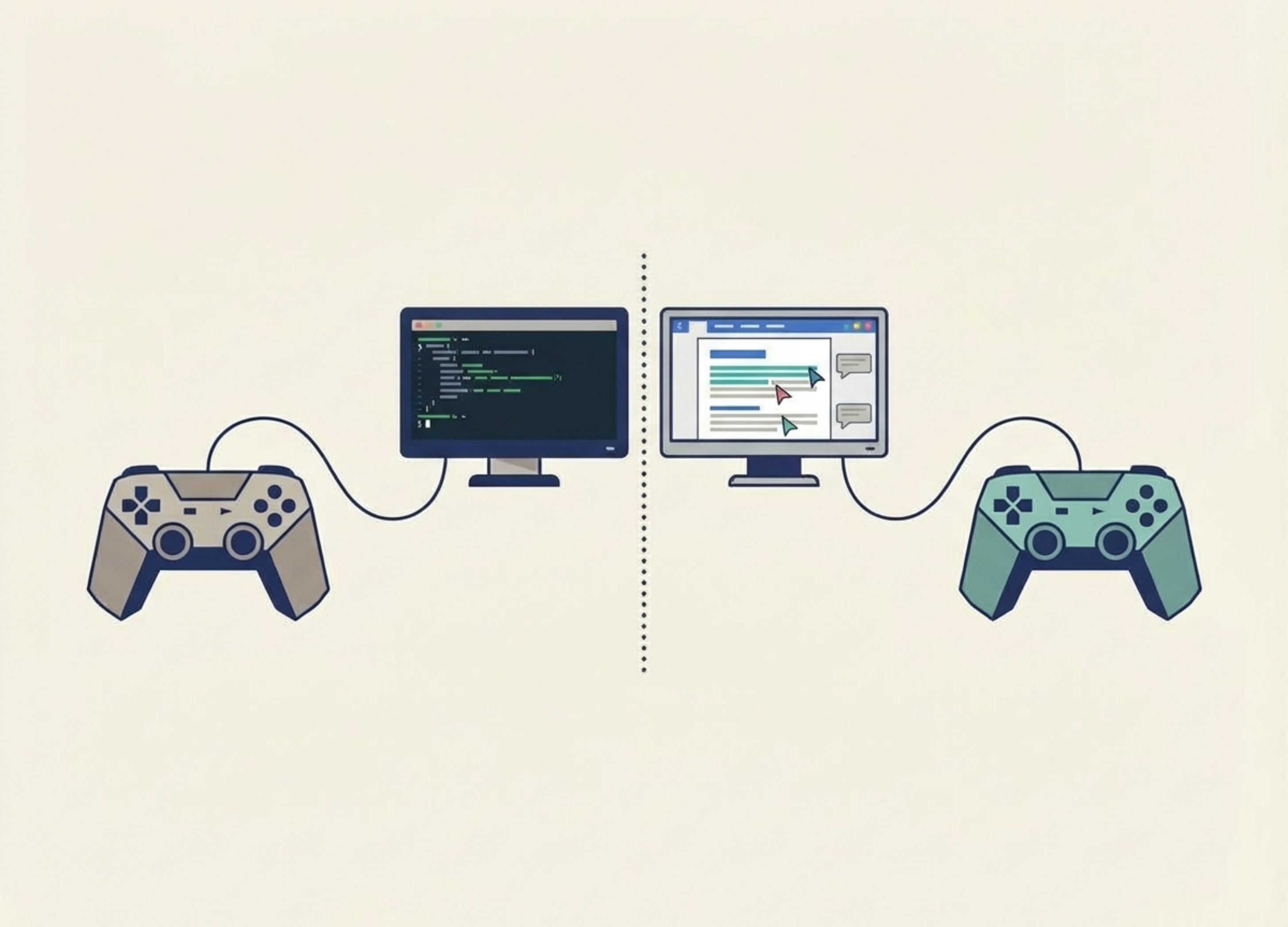
The most capable AI working environment right was originally built for software engineers, and knowledge workers adopted it anyway. The individual productivity is real, but the moment two people need to collaborate on something, they’re back to copy-paste. The multiplayer layer doesn’t exist yet, and whoever builds it will define how knowledge workers collaborate for the next decade.
I’m working with one of my partners at NextView on a strategy document. My setup: Claude Code connected to my call notes, prior research, and months of accumulated context. It produces a structured analysis with tables and recommendations, saved as a local file on my machine. For individual work, it’s amazing.
Then I need to share it. There are protocols (the most prominent one is called MCP, Model Context Protocol) that let an AI agent interact with other software, but the collaboration tools of the last decade weren’t built for agents. Claude can read a Google Doc through MCP, but it can’t write to one. So instead, I copy the whole thing and paste it into a Google Doc. My partner reads it, adds comments, restructures a section, writes in his own analysis.
Now I need to bring his changes back. Claude can pull in his edits from the Google Doc as context, but it still can’t write back to it. So I iterate locally, incorporating his feedback and extending the analysis with new material Claude surfaces. We go back and forth like this, local file to Google Doc, Google Doc to local file, with copy-paste as the bridge.
The alternative is a shared GitHub repository. Clone, branch, commit, push (the full engineering workflow) to collaborate on a document. When I was describing this setup to a friend, she jokingly suggested what we need is “MarkdownHub.” This is single-player mode: the best AI working environment I’ve used, and the collaboration workflow is copy-paste.
The accidental operating system
Claude Code was designed as a coding agent for software engineers. It lives on your computer, can read and write files, run commands, remember context across sessions, and connect to external tools through MCP. It’s a command-line tool (CLI), meaning you interact with it by typing rather than clicking, natural for developers, unfamiliar for everyone else. Then non-engineers discovered it was the most productive way to work with AI.
At our five-person partnership at NextView, four of us now use either Claude Code or Cowork (Anthropic’s point-and-click version for non-developers) daily. We use it for diligence, market analysis, deal memo drafting, strategic planning, work that most of the time has nothing to do with writing code. Each person builds their own local setup, connects their own MCPs, accumulates their own context. For one person at a time, it’s an extremely powerful setup.
The numbers suggest this isn’t niche. Anthropic’s CCO has told Bloomberg that Cowork will reach “a wider market than Claude Code,” tens of millions of developers versus hundreds of millions of knowledge workers. What started as a developer tool is becoming an operating system for knowledge work.
Because it was built for engineers, file-based markdown became the default artifact format. Non-engineers adopted markdown because it’s what works with agents. Nobody chose it as the collaboration medium for day-to-day knowledge work; the tooling chose it for them. And markdown files live in repositories, which means collaboration requires git, a version control system designed for software, not for two people who want to edit a document together. Real-time collaboration and version control are hard to do together, and nobody has solved both in a single tool that agents can participate in.
What’s actually missing
Git and GitHub have versioning and collaboration infrastructure, but they’re designed for code. Clone, branch, commit, push, pull requests, merge conflicts, and explaining what a branch is, all to do what should be “let’s both work on this.” But git is also load-bearing: agents need the ability to revert anything, and that safety net matters.
Of course, real-time document collaboration exists (Google Docs does this well), but agents can’t meaningfully participate. The most common Google Drive MCP is read-only for Docs. You can update a spreadsheet cell-by-cell, but you can’t touch a Google Doc.1 It’s a human collaboration tool that structurally excludes agents.
Proof, from the team at Every, is tackling the document layer: an agent-native markdown editor with provenance tracking and an open-source SDK. But it solves one document at a time.
The project layer — where multiple people, each working through their own agent, need to collaborate on shared work and bring results back into their own environments — is where the gap gets structural. The startups building here are well-funded, but they’re all building for engineering tasks.2 Non-code knowledge work teams have zero purpose-built infrastructure for working together through agents.
Anthropic is racing to become the Microsoft Office of the agent era
Cowork is Anthropic’s attempt to bring Claude Code’s capabilities to non-developers. Under the hood, it runs the same engine as Claude Code in a virtual machine, but wraps it in a familiar point-and-click interface with built-in connectors to tools like Google Drive, Gmail, and Slack. If you squint, the trajectory looks a lot like Microsoft Office: a hub (Cowork) with integrated apps (Claude for Excel, Claude for PowerPoint), shared context across them, and a connector ecosystem (MCP) tying it to external data.3
Cowork Projects, launched in March 2026, give users persistent multi-file context. But they’re local-only. You can’t share a project with a teammate, even on the Enterprise plan. The collaborative project layer doesn’t exist yet. Anthropic is building the Word and Excel of the agent era, but not yet the SharePoint.
Google has the actual Workspace and Microsoft has Microsoft 365, both with collaboration infrastructure and distribution, but neither has made it agent-native (Microsoft’s Copilot has 3.3% paid adoption across 450 million Microsoft 365 seats). OpenAI is merging ChatGPT, its Codex coding agent, and its Atlas browser into a single desktop “super app”, killing Sora and other products its head of applications Fidji Simo called “side quests.” The move is a direct response to Anthropic gaining enterprise share. And yet the most agent-native working environment was accidentally created by a CLI tool nobody expected non-engineers to use.
The collaboration gap between human-agent pairs, where each pair has its own context and needs to work with other pairs without losing it, is the obvious next primitive.
Open protocol or closed feature
The beauty of Claude Code is that it’s a CLI tool sitting on top of your repositories. Your context, your memory, your accumulated institutional knowledge lives in files you control, and the value accrues to your own infrastructure.
The open ecosystem is powerful, but navigating it today feels like assembling your own computer from parts: you need to know which components exist, which versions are compatible, and how to wire them together. If Anthropic solves collaboration inside Cowork, that will be compelling because it’s the push-button alternative. But then your team’s shared context, your collaboration workflows, your institutional knowledge moves inside Anthropic’s product, and the gravity shifts from your infrastructure to theirs.
Anthropic’s track record here is split. MCP was donated to an independent foundation under the Linux Foundation, co-founded with Block and OpenAI, adopted by Google, Microsoft, and thousands of developers. Cowork Projects are closed: local-only, no export, no interoperability. Which philosophy wins for collaboration primitives shapes whether the next era of productivity software is open or captured.
At least four things are missing for agent-native collaboration to work, maybe more:
Collaborating on a document shouldn’t require learning branch management. That’s a versioning problem nobody’s solved for non-code artifacts.
Shared agent memory at the team level, not just personal (each investor’s context, the deal history, the institutional knowledge that should inform everyone’s agent).
A way to know who wrote what, human versus agent. Agent provenance needs to be built in, not bolted on.
Permission scoping for shared context, so that when two people’s agents contribute to a shared project, each person controls what context crosses into the shared space and what stays private. This connects directly to the problem I explored previously in The Context Gate.
Each of these could be built as an open protocol or a closed feature, and the architecture decisions being made right now will be hard to reverse.
What the workarounds reveal
When power tools get adopted by users they weren’t designed for, the workarounds are the product insight. Non-engineers using GitHub for markdown files, copy-pasting between terminals and Google Docs, teaching colleagues what “commit” means so they can collaborate on a memo. None of this is wrong. It’s what happens when the tools outrun the infrastructure that connects them.
For the small number of people who’ve built deep agent setups, individual productivity is transformative. But the moment you need to work with another person who has their own agent and their own context, you’re back in “MarkdownHub,” toggling between a terminal and a Google Doc. Every one of these workarounds is a spec for what the next tool needs to do, and whoever reads these workarounds correctly builds the next platform.
How does your team handle it when one person’s AI-produced work needs to become another person’s AI-assisted project?
This isn’t arbitrary. Real-time collaboration tools like Google Docs use complex architectures (operational transformation) where every edit shifts the position of everything after it. Bolting agent write access onto that is non-trivial, unlike spreadsheets where each cell is independently addressable. Community-built MCP servers that support Docs writes do exist, but finding and configuring them requires the kind of engineering judgment that non-technical users don’t have.
Entire (founded by GitHub’s former CEO Thomas Dohmke, $60M at $300M valuation) focuses on agent context and governance for engineering teams. GitHub is building Agent HQ for multi-agent orchestration. Humans& (co-founded by alumni of Anthropic, xAI, and Google, $480M raised at $4.5B valuation) is building a human-agent communication platform but remains pre-product as of April 2026.
Claude for Excel launched as a native Microsoft Marketplace add-in in January 2026. Claude for PowerPoint entered research preview in February 2026. Shared cross-app context across both apps shipped in March 2026.
Uncanny - your article literally describes the gap I'm trying to close with Yjs and y/hub. Yjs is real-time git for documents: every edit is versioned, attributable, and mergeable, without branches or copy-paste. Footnote 1 is the key: that's an OT problem, not a collaboration problem. CRDTs don't have it, which is exactly why collaboration libraries like Yjs will become critical infrastructure as multiple agents start working alongside humans on the same documents.