
Show Me Your Mech
The AI-era hiring test for the kind of learning you can't fake

“Hire for the ability to learn” is still right, but the claim was never the test: anyone can say it. What’s new is the evidence you can now ask for. There’s a test for it that works in any function, and it changes who you want on a team.
I was at a breakout session at a conference recently with a room full of product and engineering leaders and a handful of CEOs, all working through the same question: what changes now that product managers can code and engineers can design? A VP of Engineering at a publicly traded company declared: nothing’s changed. You hire for the ability to learn, find smart people who can pick things up, and they’ll figure out the rest.
I think he’s right that you hire for the ability to learn. He’s just wrong that nothing’s changed.
What actually changed
The ability to learn was always what you wanted, and always easy to claim and hard to check. What’s new is the evidence: you can now ask to see what someone’s learning has actually built.
And the stakes on reading that evidence right went up, because AI multiplies what a person produces, and the multiplier depends enormously on the setup they’ve built. The gap between a strong, self-built AI setup and an equally capable peer without one isn’t a few percent; it can be several times the output. (I can’t measure it precisely, but the difference isn’t subtle.) So you’re no longer hiring the person; you’re hiring the multiplier they can wield.
Show me your mech
The sharpest answer to that comes from a repeat founder in NextView’s portfolio: almost a decade running a developer-tooling company, now building in AI tooling, very technical, with a deliberately tiny team. His hiring bar is brutal, because his own setup is so powerful that he won’t bring on anyone who’d slow him down. So his interview is one ask: show me your mech, and teach me something I don’t know about how you leverage AI.
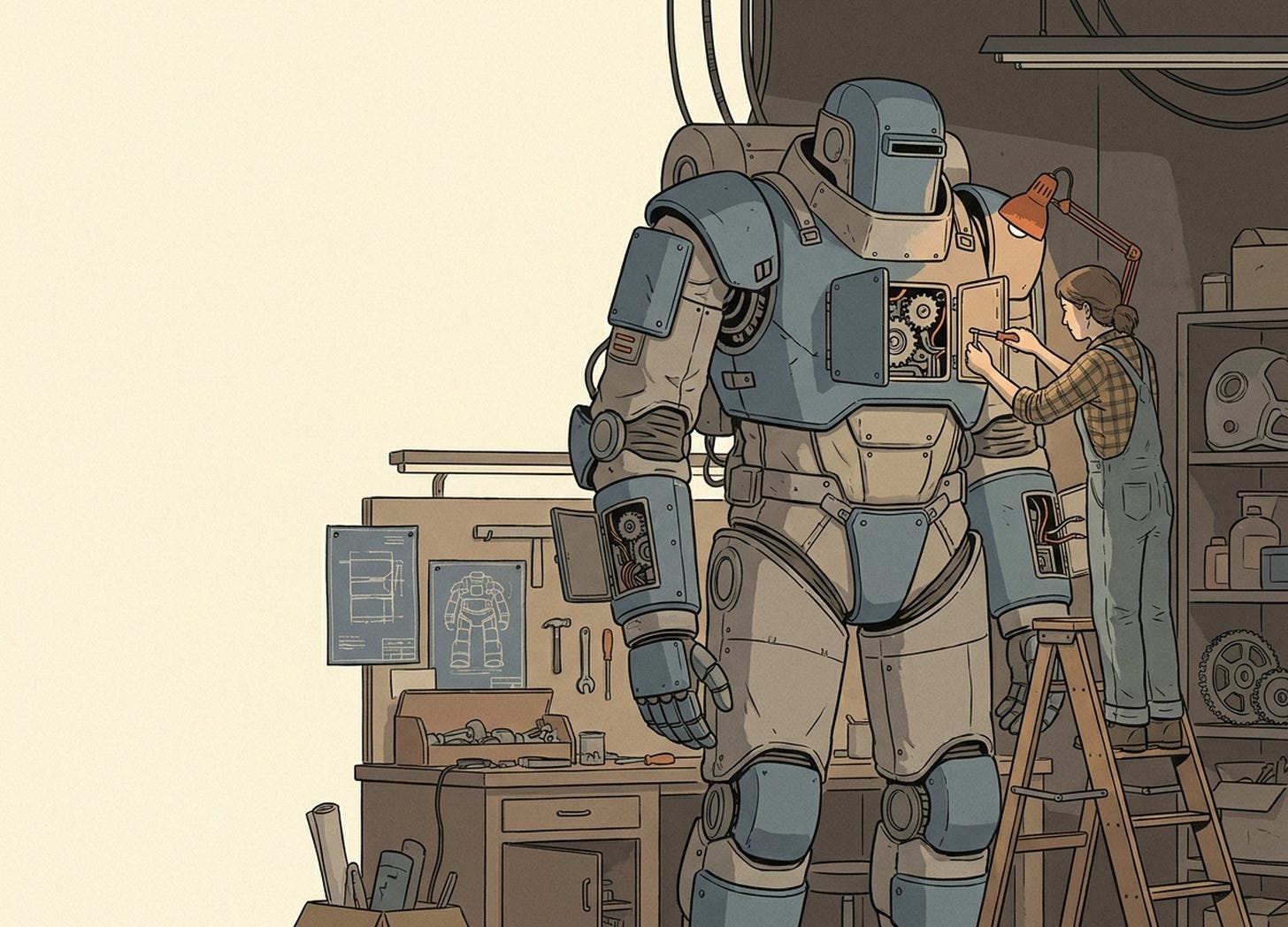
I recognized the word the second he said it. In the shows my kids watch, a mech is a powered robotic suit a pilot climbs into. It makes the pilot far stronger, but it’s still the pilot flying it. Someone’s AI mech is the tooling and workflows they’ve built around the shape of their own work: coding agents and custom skills for an engineer, a research-and-drafting stack for a marketer, a data-to-first-draft pipeline for an analyst.
What makes a mech worth asking about is that it’s self-assembled. The base can be handed to you (plenty of companies now build their own custom coding agent as shared infra), but the mech is the layer on top: how you’ve shaped your own setup and how well you wield it. Hand two people the identical tool and they still produce very different output, because the multiplier comes from the person. You can’t buy that off the shelf or fake it; it’s the accumulated residue of someone solving their own problems over and over. That’s what makes it evidence of learning rather than tool-ownership.
You’re still hiring the person, but the mech is the clearest window into how they learn when no one assigns the curriculum. A portfolio shows outputs (often old, sometimes a team’s), while a mech shows the production system and the frontier they work at right now. That’s what the second clause does: “teach me something I don’t know” turns the interview from judging someone’s past into watching them show you a piece of the future. That’s how you tell a real practitioner from someone who’s only ever run the defaults.
But the move worth stealing is to lift his rubric into a general lens, because a practitioner working at the extreme often reveals a principle the rest of us can use in a milder form. And it isn’t specific to engineering: the recruiter who automated her sourcing is showing you the same thing the engineer is.
Running the test
To run it, get concrete: what did you redesign, and what broke first? Someone who’s shaped their own setup answers instantly and in detail, while someone who’s only ever run what they were handed goes vague exactly where the self-directed learning would show up. The size of the mech matters less than whether they’ve shaped one at all.
You’re screening for a disposition, not a tool list, so it isn’t elitist. Someone who’s never touched AI isn’t disqualified; it just shifts the burden to finding the learning evidence elsewhere. The mech doesn’t replace what you already evaluate (domain depth, judgment, taste). It’s an added layer. And you don’t need a mech yourself to run the test, since anyone can tell teaching from hand-waving; for the deeper read, loop in someone who wears one in that function.
What it changes about teams
Why want mech-wearers beyond speed? They make a team T-shaped: deep in one function, credible across several. Role-blurring doesn’t mean roles collapse. A product manager who can code is still a product manager, working at roughly an average engineer’s level (a “1x”) but not beyond it. A mech activates the horizontal bar of the T, so a specialist can flex to a credible 1x in an adjacent function instead of stalling.
The stalls usually happen at the seams between functions: the marketer waiting on the analytics team for a data pull, the product manager waiting on engineering for a prototype. A mech-wearer fills those white-spaces, so the chain stops breaking every time work crosses a boundary.
It’s also changing what a senior career looks like. If one person carries both depth and breadth, they can operate with close to the leverage of a small team, which makes going back to individual-contributor work look very different than it used to. Peter Bailis, the former CTO of Workday, recently left to become a “Member of Technical Staff” at Anthropic (the same title it gives a new-grad engineer), one of several CTOs of billion-dollar companies who’ve made the move in the past year. Put enough mech-wearers on a team and it out-produces one several times its size: the leverage compounds at the org level, not just the individual.
You’re hiring the learner
So the VP of Engineering at the breakout session was half right. You are hiring for the ability to learn, the way you always were, but what changed is how you get evidence of it. “I’m a fast learner” is a claim anyone can make, while “here’s the mech I built, and here’s something I can teach you” is proof you can see. So if you’re staffing a team now, stop asking people to describe how they learn, and ask them to show you what that learning already built, whatever their function.
Previously in Ground Truth: The Structural Divide argued that individual AI productivity doesn’t automatically scale to the organization, because the gap is structural, not behavioral. The mech test is one lever on the human side of that gap: who you hire determines how much of the individual flywheel your team actually captures. The Country of Geniuses Test asked which parts of your work survive as AI gets cheap, and what scaffolding you have to author yourself. The mech is how you recognize the people already building that scaffolding for their own work.