
The Memory Problem Isn't Retrieval
What's actually solved in AI memory, what isn't, and the gap you keep hitting

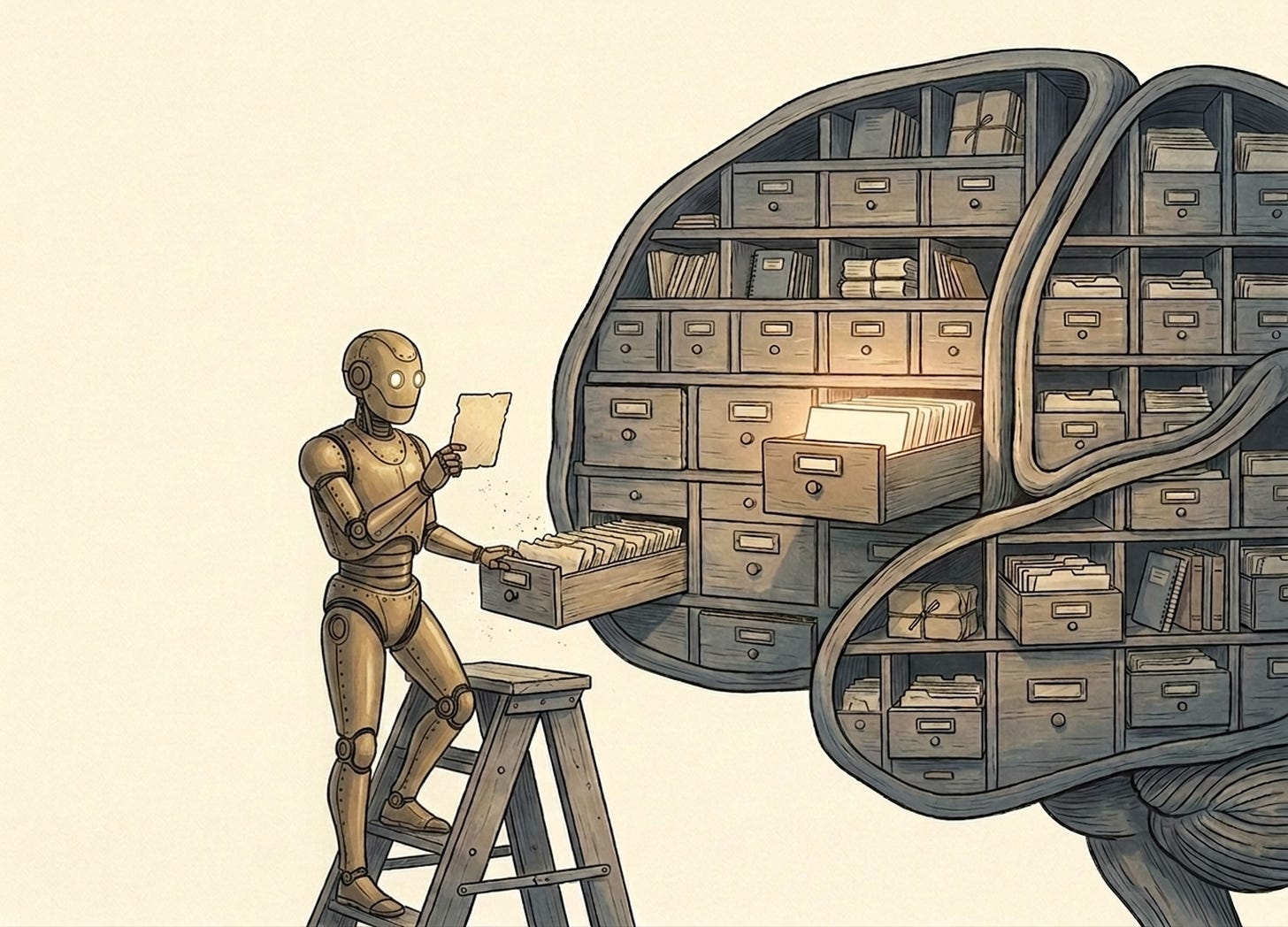
AI memory’s real failure is a quiet one: an agent hands you the version of something that already changed but you never catch it. Retrieval, the part the field keeps racing to improve, is not where memory actually breaks.
A few weeks ago, an agent I run as a chief of staff told me, with total confidence, that a problem was still open. I knew it wasn’t, because I’d fixed it that morning. An hour later it opened a document to edit and started from a version I’d already revised, as if the revision had never happened. Then, in its end-of-day summary, it listed a decision as still-open that we’d already settled hours earlier. The only reason I caught any of them was that I happened to be the one who’d made the changes.
It hadn’t lost the work. It could find the current state fine; nothing flagged the version in its head as out of date.
If you’ve spent time around any large organization, you’ve met the human version: the colleague who confidently quotes a policy that was rescinded six months ago. The difference is that a person usually hedges (”last I checked”), and the agent doesn’t.
For me, that cost a few minutes, because I was the one watching. The same failure scales with whatever you let the agent do unsupervised, and the whole industry is racing to let it do more.
Everyone is racing to make AI remember more
Almost all the energy in AI memory right now goes into one thing: helping models remember more. Bigger context windows, better search over your history, knowledge graphs that store what the model has learned. One of the clearest public maps I came across was Chrys Bader’s thread from April 2026, “Why long-term memory for LLMs remains unsolved”, which maps how retrieved memory gets crowded out by noise. It’s a good map, and it’s the frame most of the field is working inside.
The failure I hit lives somewhere else. My agent remembered the decision fine, it just remembered the wrong version of it. Finding what it knows is one axis; knowing whether what it finds is still current is another. Call the second one currency.
What’s actually solved, and what isn’t
Memory does two jobs. The first is finding what you stored, the recall problem, and it’s the part the field has pushed furthest. The best systems surface the right memory around 99% of the time in tests and around 85% in production.1 Those are the strongest numbers anywhere in agent memory, and they still aren’t good enough to call the problem solved: at 85%, the system comes back with the wrong thing (or nothing) about one in every seven tries.
The second job is knowing whether what you found is still current, and here the picture splits depending on how your memory is organized. If you’ve gone to the trouble of storing it as a database where every fact is filed with the date it became true and the date it stopped being true (a rigid, structured setup), the bookkeeping is largely handled.2 Almost nobody runs their memory this way, though. It takes real upfront work, and it only covers the facts that fit neatly into the structure.
For the messy, general memory most people and most products actually use (notes, documents, accumulated text and conversations), knowing what’s current is basically unsolved, and you can watch it in what the vendors ship. The most widely used memory layers have quietly moved toward adding new facts next to the old ones rather than replacing them, and letting search sort out which one wins.3 One vendor’s own June 2026 “State of AI Agent Memory” report admits that a stored fact can go “confidently wrong” when the world changes, and that staleness “is a harder, open problem.” Meanwhile most of the new research filed under “memory” is about helping agents forget low-value details, not about keeping the important ones current.4
Where currency actually breaks
That second job fails in two ways. The first is the one from the top of this piece: a fact has an old value and a new one, and the agent reaches for the old one. The second is keeping a change consistent everywhere it lives.
My own agent once paused a set of background jobs and noted it in one file, but left three others saying they were still running. Later it read its own contradictory notes and flagged the jobs as broken, never realizing it had paused them itself. The information wasn’t missing; it was written down in one place out of four. A May 2026 paper named STALE catalogs exactly these two, a “co-referential” conflict and a “propagated” one. I’d run into both long before they had names.
Why you can’t see it happening
The reason this is easy to miss is the thing I noticed first: the agent is just as confident when it’s stale as when it’s current. A builder on the r/openclaw forum described the mechanism well: old notes “came back with the same confidence as fresh decisions,” and the model “had to somehow figure out which one had authority... not because retrieval failed, but because retrieval was too flat.”
My first instinct was that this was because I was bad at keeping my own files current. Some of it is: cleaning up the files helps, and a structured store closes the structured part. But the harder piece didn’t go away.
In the STALE benchmark, one of the memory systems they tested surfaced the updated fact in about 77% of cases but flagged it as worth acting on in only about 3% of the time. The frontier models fail the same way: one of them caught a stale fact 92% of the time when asked about it directly, but only 30% of the time when a question quietly assumed the old fact still held. The updated information is right there, and it still doesn’t get the weight to override what came before.
I see it in my own setup. The agent keeps an auto-memory file, MEMORY.md, where it writes down on its own what it judges worth remembering. Months ago it filed a rule there and marked it settled; later I replaced that rule, but the old one stayed, and for weeks the agent kept steering by it, never weighting the replacement over the version it had already filed as settled.
It only gets more expensive from here
The reason this has only cost me minutes is that I’m still the one checking it. The dominant direction of AI is to take the person out of the loop and hand agents the consequential work of deciding, executing, and running whole workflows. The pitch you keep hearing is the agent company, where you build your own company brain: a growing store of your decisions, policies, and constraints that your agents read from and act on. Every confidently-stale entry there is a decision made against one you already reversed, and no one catches it.
The most ambitious agentic products run on the same bet. These are digital twins, always-on assistants, agents meant to know you, and their whole promise is an accurate, living model of who you are. One that’s confidently wrong about your job, your relationship, or what you decided last month is broken in the way that makes you stop trusting it. The founders building these treat temporal memory as the first problem to solve, not a feature to add later, because there’s no product underneath it otherwise.
Even the frontier labs are circling it from the outside. Agents are now told to write memories automatically, which helps them remember more and does nothing for knowing what’s still true, so the notes pile up faster than anything retires them. The labs’ answer is a periodic “dreaming” pass that goes back through the store and rewrites stale entries to their current value.5 Running it offline is the right call, but the real constraint is judgment: rewriting a stale entry requires knowing which value is current.
And a settled fact that changed is the easy case. Some of what an agent stores is a perspective still being worked out, moving faster than anything gets written down. On a strategic project I’m working on with one of my partners, my agent’s memory holds one structural decision as settled doctrine. It isn’t: we’re still working out the long-term shape, and on a recent call I floated changing it entirely. The current view lives in that ongoing work, not in the memory. Nothing has forced the agent to choose between them yet, and when it does, the answer it’s surest of will be the stale one.
The question worth asking
The real question about any agent you’re starting to trust is whether it knows which of the things it remembers is still true, and acts on that. Recall is becoming something you can buy; that judgment isn’t (at least not yet), and it’s thinnest exactly where we’re most eager to put agents in charge.
For now, the only thing between you and a confidently stale answer is a person still in the loop to catch it, and that person is exactly what the rest of the industry is racing to design away.
On the standard long-memory benchmark, Supermemory’s experimental system scores around 99% and production systems cluster around 85%. Tools like Tobias Lütke’s qmd, a popular local search engine over your own markdown files, are pure retrieval: better at finding, with no notion of which version is current.
The clearest example is Zep’s Graphiti, which stores each fact with the dates it was valid and marks a contradicted fact invalid rather than deleting it, so only the current version surfaces. It’s worth about +18.5% on the benchmark, for the conflicts a rigid schema can represent.
Mem0 rebuilt its production system around adding facts rather than replacing them, so a “stale-but-relevant memory can still surface... it just no longer competes as if it were equally current forever.” Letta takes the other route: the last write wins, and which version is current is left to the agent’s own judgment.
The 2026 “temporal memory” papers cluster around decay and forgetting rather than supersession: TSM, FadeMem, SuperLocalMemory.
Anthropic’s “dreaming” (Claude Managed Agents, May 2026, research preview) reads an agent’s memory plus past sessions and produces a rebuilt store with “stale or contradicted entries replaced with the latest value.” The rebuild is only as good as its read on which entry is current: it can override an old fact when something in the recent record visibly contradicts it, but a fact that was quietly superseded, with nothing on record arguing against it, looks current and stays.